
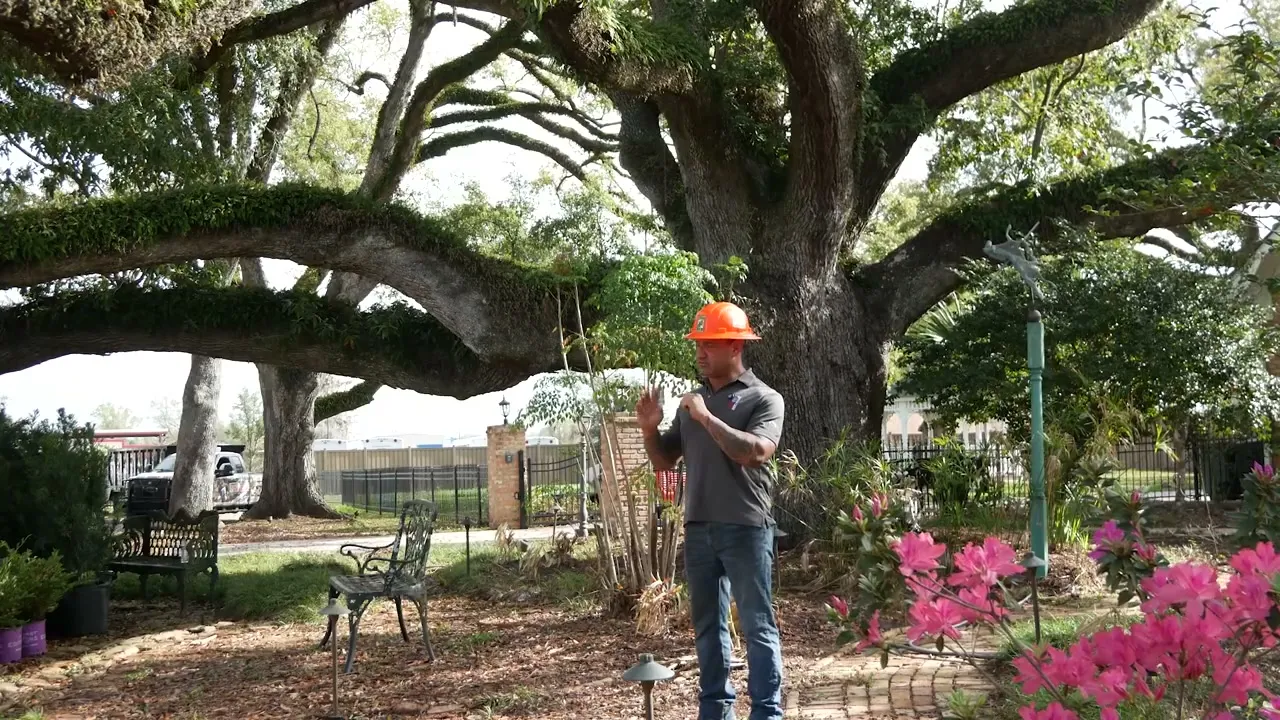
Historic & Mature Tree Preservation
Restoring the Root Zones of 200-Year-Old Live Oaks
Houma, Louisiana
A veteran homeowner in Houma asked us to protect some of the oldest oaks in the neighborhood for generations to come.
- Tree species
- Southern live oak
- Approx. age
- 150–200+ years (arborist estimate)
- Project type
- Historic tree preservation · Root-zone restoration
- Year
- 2026
- Client
- Private veteran homeowner
 Primary arborist
- Ricky Folse
The Challenge
Several mature live oaks, including one Ricky believes may be among the older oaks in the parish, showed no obvious distress. But soil and mulch had been piled against the trunks, landscaping crowded the root zones, and years of foot traffic and parking had compacted the soil.
The Assessment
Air-spade excavation exposed the root flares for inspection. The structural roots were healthy, but two girdling roots were found that would slowly constrict the tree as it grew. Compacted soil and turf competition were limiting water and nutrients to the feeder roots.
The Solution
Veteran Tree Care cleared the root flares, cut the girdling roots, and used the air spade to decompact soil along the drip line. A soil blend of mycorrhizae, microorganisms and biochar was injected into the root zone, using deeper injections where landscaping plants would otherwise take up the treatment. Fresh whole-tree arborist chips were then spread, kept off the trunk, to rebuild a forest-floor layer.
Why this approach
Live oaks evolved as forest trees. Leaf litter, fungi and loose, living soil supplied what they needed. Restoring those conditions protects surface roots, holds moisture through drought and cold, and feeds the soil biology that makes nutrients available. Over time it does more than repeated fertilizer.
The Result
Root flares exposed and protected, girdling roots corrected, compaction relieved and a soil program in place, with re-inspection planned and annual chip top-ups to keep 4 to 6 inches in place.
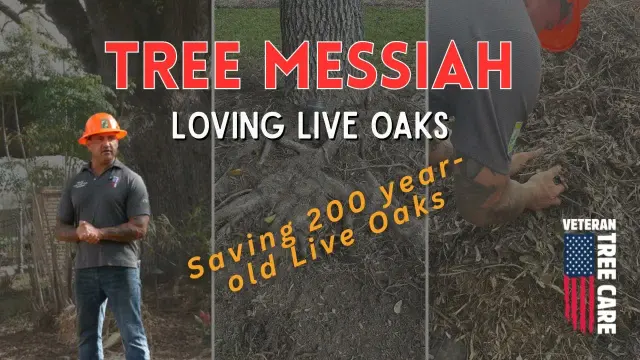 VideoWatch the project video (18 min)
Documented in Loving Live Oaks, Episode 2 (March 2026).
The arboricultural science
Techniques Used on This Project.
Only the methods actually used on this project are listed.
- Air-spade excavationCompressed air exposes the root flare and roots without wounding them.
- Girdling-root correctionRemoving roots that circle and constrict the trunk.
- Soil decompactionReopening compacted soil so water, air and feeder roots can move.
- Tree / soil injectionsDelivering treatments, biology or nutrients where the tree can use them.
- Soil biology restorationEcto-mycorrhizae, humates and charged biochar to rebuild living soil.
- Root-zone protection with arborist chipsWhole-tree wood chips insulate roots, hold moisture and feed soil life.
- Ongoing monitoringScheduled re-inspections to track the tree’s response and adjust treatment.
Start with an arborist
Have a Project Where Experience Matters?
-
Residential tree work
Pruning, removal and stump grinding, planned and done by the arborist you meet.
Join the waitlist -
Advanced arboriculture
Historic trees, risk assessments, legal or insurance questions, construction planning and commercial work.
Schedule an arborist consultation -
Emergencies
Trees on homes, cars, roads or lines. 24/7.
Call now -
Veterans
Structure, camaraderie, purpose and a path to leadership.
Continue your mission with us